Monday, 14 March 2022

10. Oxford: Magdalen College Choral Evensong and St Aldate's 10am Service: March 2022


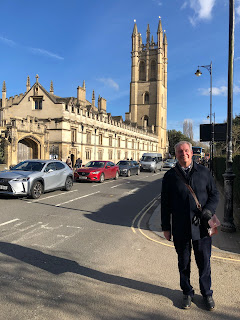
Last weekend we visited Oxford on two sunny spring days.  Saturday was the last day of Hilary Term, students returning on 24th April for Trinity, so, perhaps, there was something of a ‘demob’ happy atmosphere in the streets!

On Saturday evening, at 6.00pm, we attended Choral Evensong at Magdalen College.  The chapel, both inner and anti-chapel, was packed and we were fortunate to sit alongside the choir in this utterly beautiful, candlelit setting.  Throughout the fifty or so minutes we were able to follow the service in a clearly presented booklet that contained both the ancient words and rubric instructions telling us when to sit or stand.

Of course the language was quite specifically ancient, almost five hundred years old.  This liturgy was put together during Cranmer’s time, an Archbishop of Canterbury who wanted the nation to pray in English and hear the bible read extensively in ordinary services.  What may sound archaic to us today was revolutionary in the 1540’s!  What is still so wonderfully apparent is the sheer amount of scripture in Evensong, with both the singing of a psalm and readings from both Old and New Testaments.
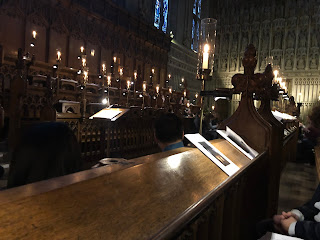
On Saturday we heard the choirs of Magdalen College and the Consort of Voices, that is a collection of girls from other colleges. This meant there were no less than 36 in the combined choir and what a clear and strong lead they gave.  Youthful voices have a very specific and inspirational beauty about them.

Maybe the packed nature of the service had something to do with it being the final occasion of term, along with the last outing of the old organ, due to be replaced by a brand-new instrument over the next few weeks and months.  Yet, it was clear that for many worshippers that evening this was a deeply moving service into which they entered with immense sincerity.

It was odd to learn that no services will be held in the chapel until Maundy Thursday.

Maybe for me the most uplifting moment came in the final hymn we sang together: Abide with me. As a packed chapel combined with a large choir the music simply soared, especially in the final verse with a stunning descant.  I felt my voice break with a certain unforced emotion, glad to share such a truly beautiful moment in a glorious setting surrounded by so many young people.
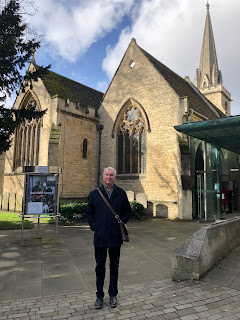
On Sunday morning we attended one of four services being held that day at St Aldates, opposite Christ Church College.  This is a flagship Evangelical Anglican church.  Today in England 40% of Anglican worshipers would describe themselves as ‘evangelical’ along with 70% of current ordinands.

We could not have wished for a warmer and more sincere welcome from everyone.  I suppose we knew exactly what to expect because St Aldate’s website is so informative and its weekly webcasting so professional.

After a brief welcome by the young rector, before we went ‘live’, we stood for some twenty-five minutes of worship led by the band.  These six singers and musicians filled the chancel area and were heavily amplified.  I knew just one of the songs and enjoyed their musical leadership of it.  It was interesting to observe that probably half the congregation joined in enthusiastically, some using all the body, whilst about half simply stood without singing.  In truth the amplification was such that the contribution of the congregation hardly registered any extra decibels anyway.  I was left pondering what is to me a new phenomenon, that some (and these were younger people) are happy to be led in song rather than sing themselves.
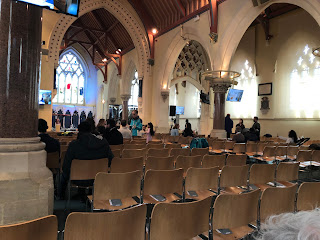
It was lovely to see so many children present.  We were told by our neighbours that students usually attended the evening services, so the 10am was very much for young families.  The children and early teenagers left after about ten minutes and there must have been way over 100 of them going to their own dedicated time.  How wonderful to see such a ministry flourish in a city centre.

Indeed the service was, basically, attended by ‘first half of life’ adults.  Anyone over fifty was in the minority – and that, surely is the inverse of what we find in most churches.

There was, at various points in the service, quite an emphasis on giving, especially as the previous week was the church’s Gift Day.  With 38 full time members of staff and a budget of £1.6m this is a church that needs a very committed congregation.

The sermon, on the theme of praying in a time of war, was beautifully and thoughtfully delivered by St Aldate’s Pastor for Theology.  It was brilliantly crafted, and although it rather left the question (perhaps understandably) unanswered as to what happens if prayer doesn’t stop a war, it was clear that in those 25 minutes many helpful and insightful truths were shared with a congregation eager to listen and learn.

There was around 400 of us at the 10am service and there were three other services that day.  Later, on Sunday, I glanced at the webcast and saw that over 700 had tuned in.  St Aldate’s ministry is clearly a great blessing to thousands of people, many of whom are young and at the start of their faith journey.  It is a church with a real sense of love for Jesus Christ at its centre and a deep desire to serve the city of Oxford. 

So, what do I conclude from our forty-eight hours amongst the dreaming spires of Oxford?  Well, in a sense Magdalen had the aura of Canterbury about it, whilst St Aldate’s was probably more Glastonbury.  The amazing thing is that both churches, so diverse from the other, belong to the same denomination: The Church of England.  And therein probably lies a great strength, that such diversity can be accommodated and used so positively to reach out to different types of people.  Yet, at the heart of both expressions this weekend I felt a deep sincerity, based in a desire to honour God, that I found inspirational.  I also discovered that 20-year-olds (all be it not the same ones) can and do enjoy both Cranmer and Stuart Townend!

Thursday, 3 March 2022

9. Greyfriars Church of Scotland, Edinburgh: February 2022


During our February half-term break in Edinburgh I attended the 11am Sunday service at Greyfriars Kirk in the Old Town; a church made famous by its association with Greyfriars Bobby, the tale of the dog who refused to leave his master’s grave in the kirkyard.


Scotland, at least on February 20th, still had the Track and Trace policy regularly in force, so I duly gave my details to the very welcoming young man at the church’s reception.


Greyfriars was the first church to be built in Edinburgh after the Reformation.  Therefore, unlike St Giles Cathedral just a stone’s throw away, it has never had a previous life as a Roman Catholic church.  Today it is beautifully maintained and has, in recent years, been ‘re-ordered’ with the installation of a circular Communion Table, behind which the grey robed choir sit, and to the other side the congregation is seated.

Nothing much happened before 11am, but as the hour chimed so the bible was brought in and placed in the pulpit, followed by the entrance of the minister as the organist played the opening voluntary on the splendid new instrument installed in the gallery.

Being a Church of Scotland service, we began with a Welcome and Call to Worship.  In truth, I was entirely at home as the liturgy was basically the same we use at AFC.  It reminded me of just how much Amersham Free Church reflects the worship traditions of The Church of Scotland.

Greyfriars has a very well maintained and informative website, so I had ‘seen’ the service many times before.  I’ve also had the delight of listening to its minister, The Revd Dr Richard Frazer on both the Sunday and Daily Services on BBC Radio 4.

The welcome I received was very friendly and the hymns were carefully chosen (although I was surprised by the lack of volume coming from the congregation, who seemed to rely heavily on the choir leading the worship).

For me, I confess, the most inspirational part came in the sermon.  The minister’s style was gentle yet authoritative, he took his theme from scripture and worked hard at applying it to life.  He preached a brave sermon, full of integrity, warmth, balance, and insight.  Richard Frazer is a gifted preacher, and it was a real privilege to hear him.

Greyfriars was far from full that morning.  Indeed, I attended this service having just come from an earlier one at St Gile’s Cathedral that was equally empty.  Maybe Edinburgh just has far too many churches for the dwindling numbers attending.

On Sunday morning, at Greyfriars, I attended a service where every word, in both liturgy and sermon, had been thought through with such meticulous attention and care.  The city is blessed to have such a fine church and such an inspirational minister.  Indeed, if it were my city and home, I would be in my seat every Sunday at Greyfriars at 11am, thankful to God for such a community of faith.

Tuesday, 11 January 2022

8. Farm Street Roman Catholic Church, Mayfair, London: January 2022


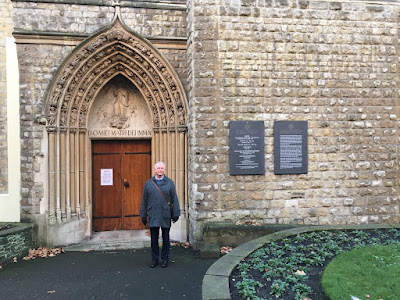
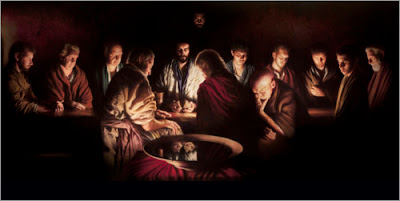
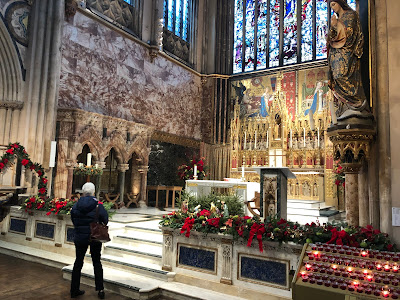
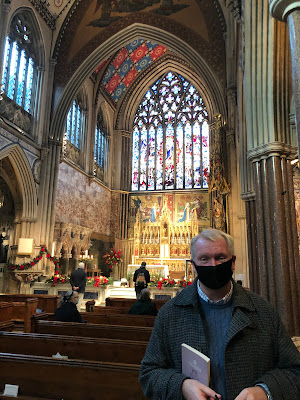
Over the Christmas/New Year holiday we called into Farm Street Church (we were just passing) and felt we had discovered a much-loved building.  One thing that struck us straight away was the huge painting by the church’s artist in residence, Andrew White.  It’s a modern depiction of the Last Supper and it had me transfixed; I love it.


So, we decided it would be good to join the congregation on one of my Sabbatical Sundays and so we visited them for their 11 o’clock service (one of six they hold every Sunday) on 9th January 2022, a sparkling, blue sky mid-winter day in London.

We’d already discovered a very helpful website and so we appreciated that this would be a service held in Latin with the professional choir in attendance, as opposed to the 9.30am service which was a Family Mass in English, and the 5.30pm service with ‘informal’ music.


Farm Street (incredible to think this area of Mayfair was once Hay Hill Farm!) is a Roman Catholic Church and was established in the mid 1800’s by the Jesuits, around the time when the Roman Catholic hierarchy was restored to England after years of discrimination, even persecution.  It makes a bold statement even today with its very powerful neo-gothic architecture.  I found it a very welcoming space, one that ‘envelopes’.  On this occasion it was still rather beautifully decorated for Christmas.


I confess that at 10.55am it did all seem a little last minute!  People were arranging service books and communion vessels in the chancel, the choir only just managed to get to the gallery by 11 am and only about twenty people seemed to be present.  However, by 11am, although not a minute sooner, everything was in order and the congregation had at least tripled!  From that point on this was an utterly seamless and well-ordered service.

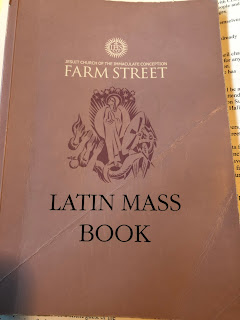
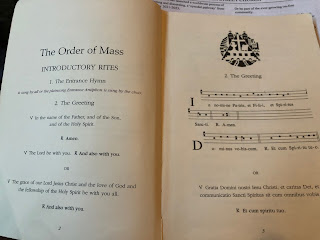
I appreciated the service book which doubled as a hymn book (with 80 hymns at the back) because alongside the Latin text, clearly loved and appreciated by the congregation, there was an English translation.


We sang just one hymn during the entrance procession and to be honest not many people did!  Obviously in Free Church worship hymns are foundational to worship, on Sunday it was clear that the liturgical responses, mainly sung by the choir, took their place in this service.  And the choir, ten of them, were great!  The music (organ and voice) was so uplifting.

We had a super American reader who led the lessons and intercessions from the pulpit.  She did so with warmth and great poise.  The intercessions were relatively short and consisted of Bidding Prayers.

The priest, one of seven connected with the church and living in the Jesuit community next door, gave a really helpful and warm-hearted homily of six minutes on the theme of Christ’s baptism and related it to all those seminal moments that come our way when God is close, and we discover something of our place and mission in the world.  Here was a pastor gently encouraging his flock and doing so with such gentle sensitivity.


The service proceeded without announcements, everyone seemed to know exactly what to do at the right time.  After the prayer of consecration, I looked up and realised only Rachel and I were not kneeling!  The sense of deep sincerity was palpable.

Although predominately ‘retired’, there was a mix of ages with a number of children present.  I looked at one little boy, so excited to be going up for communion and cupping his hands in anticipation with a big smile on his face.

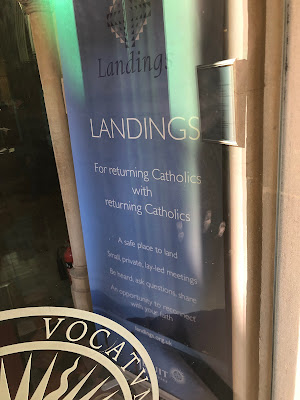
One of the interesting ministries at Farm Street is called ‘Landings’.  A programme designed to help Roman Catholics ‘return’ to church if they have been away for some time.  These meetings are run both by and for ‘returning’ Catholics.


Another significant ministry, set up with the blessing of Vincent Nichols, Archbishop of Westminster, is that Farm Street actively reaches out and welcomes members of the gay catholic community.  They are encouraged twice a month at the 5.30pm Mass to ‘contribute’.  Surely this is to be commended.

Personally I have attended very few Roman Catholic services, and I’m in no position to make any specific critique of the Church’s traditions.  However, on Sunday at Farm Street I came away with one overriding impression.  SINCERITY!  I think we encountered a community that so desired for Jesus to be at the centre; indeed, at one point the priest said: Your personal relationship with Jesus Christ is the most important thing in the world. 

The folks on Sunday may have been expressing that relationship in a tradition with which I am unfamiliar, but I came away in no doubt that the love of God in Jesus had been very evident among us as we gathered.  We both felt it and walked off to lunch pleased to have shared in worship with such a sincere congregation in the centre of Mayfair.


I felt I learnt a lot about my Roman Catholic brothers and sisters on Sunday and I was very glad to be in their company.


Monday, 10 January 2022

7. St Stephen's Walbrook, City of London: January 2022


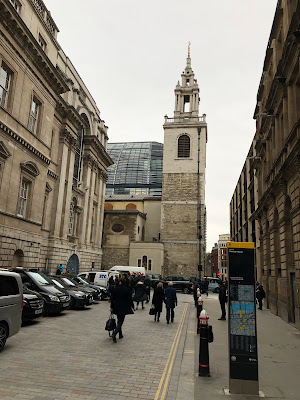
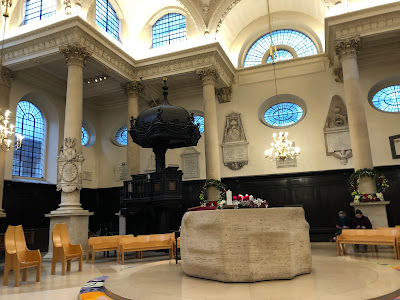
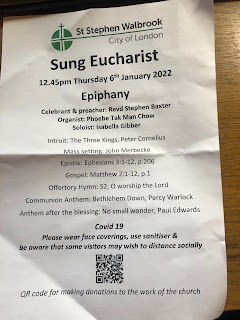
On a recent ‘day off’ I attended the lunch time Sung Eucharist at St Stephen’s Church, Walbrook, next to London’s Mansion House.  This is the church where The Revd Chad Varah, founder of The Samaritans, was vicar.  It’s an architectural masterpiece designed by Sir Christopher Wren with a stunning domed rood, yet it has recently been ‘modernised’ inside with ‘circular pews’ around a central stone altar.


I was encouraged, as I approached the church, to hear its bell ringing out announcing that a service of worship, at which about 30 would attend, was about to commence.  I was given a very warm welcome and handed both hymn book and service sheet. 

This service, held every Thursday is recorded and then uploaded onto the church’s website on Saturday, effectively also becoming their Sunday eucharist too.  St Stephen’s, being in The City, is not really a weekend church, catering instead for a weekday congregation.  Indeed, the young man attending the service in the pew in front of me slipped out quickly after the blessing, I presume his lunchbreak was up and he was off back to the office.


It struck me that so much effort had been put into this lunchtime service, as in many senses it was the church’s main event of the week.  That meant there was wonderful music provided by a young lady organist who played beautiful, with a soloist who sang some inspiring anthems.  The clergy and helpers were dressed in full attire and there was a significant sense of ‘occasion’ during the 45 mins we were together.

St Stephen’s uses a communion liturgy based on the Anglican 1928 Prayerbook, the one never sanctioned by parliament!  This prayerbook has a lot of words!  I suspect that compared to the AFC Communion Liturgy it was three times as long.  I think it made me realise what a wonderful opportunity Free Churches have of writing their own liturgy, spending time crafting words that give a nod to history but reflect the rhythm of the way we speak today.  It’s also true that so many words give the officiant the great challenge of ‘getting through them’ without speaking too quickly.


It being the Feast of the Epiphany, the characters of the three kings were ceremonially put into the church’s crib scene at the beginning of the service, complete with incense.  Indeed we were told that St Stephen’s keeps a ‘long Christmas’ right up to 2nd February and the Feast of Candlemas, and until then the Christmas Tree will stay in place!

The sermon was very good and finished with a tribute to Desmond Tutu who died on St Stephen’s Day last year.

During the offering I was interested to see that not only did the steward hold a basket for cash and envelopes, but in the other hand was a card machine and, indeed, some people around me did swipe their cards as they sang the offertory hymn!  Times are changing!


After the service, although I didn’t stay for it, a light lunch was served at the back of the church and it was obvious that this gathering would be well attended by folk who made it their regular ‘meeting up’ time.

I came away so impressed by St Stephen’s Walbrook and its integrity in doing something so relevant to its context, that of a Thursday lunchtime Eucharist.  Such energy and commitment is keeping this community of faith alive and vibrant and maintaining a wonderful witness to Jesus Christ at the centre of the City of London.

Wednesday, 5 January 2022

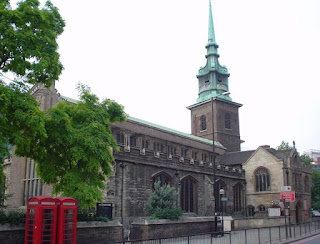
6. All Hallows by The Tower: December 2021


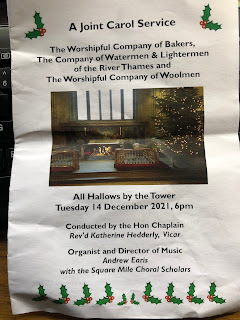
On a dark Tuesday evening in Advent 2021 I attended the Worshipful Company of Bakers’ Carol Service at All Hallows by The Tower.  I had been invited by Sara from our congregation, herself a Master Baker.

I’ve visited All Hallows on a number of occasions but never for a service. I’m usually there because it’s a church often included in Christian Aid’s Circle the City circuit.  It is impressively placed, lover looking both the Tower of London and Tower Bridge. 


The church was bombed in World War Two and extensively rebuilt afterwards.  Its one time Vicar was Tubby Clayton, the famous war time chaplain and founder of TochH.

It was a delight to be in Sara’s party for the carol service and the evening was shared with two other Companies, those of the Woolmen and Watermen. That thrilled me somewhat as my eight times grandfather was a Waterman in the 1700’s based the other side of the river at Southwalk.  Members of these honourable companies read the lessons, often dressed in their colourful robes.

It was a lovely traditional service and we were blessed to have music provided by the Choral Scholars of The Square Mile Singers.
  This group has been recently formed by Andrew Earis, the Director of Music for St Martin in the Fields.  For many years now St Martin’s has provided bursaries for choral scholars and Dr Earis has now broadened this to provide singers for other city churches including All Hallows and St Stephen’s, Walbrook by The Bank of England.  It is a super idea and is a great gift to these city churches to have the services of such wonderful singers.


The Vicar of All Hallows, Katherine Hedderly gave the warmest of welcomes and led the service beautifully.  I was impressed that she also gave a sermon!  She focussed on the church’s work with refugees from Afghanistan and told us of a forthcoming evening when these folk were due at the vicarage to cook a meal for the community.  It was truly inspiring to hear of this ministry.

Being a church in such a famous context yet without too many resident in the parish must be very challenging, yet I sensed that the Revd Katherine and her team were calm, committed and upbeat.

The evening was a wonderful example of the Church interacting with its community.  Playing host to three of London’s ancient Guilds was just that, touching base with neighbours, offering hospitality, respecting each others’ contribution to society and standing together as a force for good and God in that specific locality.

Thursday, 26 August 2021

5. Southwark Cathedral: August 2021

 Well, after a long break since February 2020 due to the Pandemic, here we are again visiting another congregation, this time Southwark Cathedral by the Thames and next to Borough Market and The Shard.  St Paul's serves the north side and Southwark the south side of London.


The excellent cathedral website contained all the information we needed to plan our visit.


We were welcomed by cheerful and helpful stewards and took our place, wearing face masks, in the nave.  The chairs had been thinned out, four in a row bunched in twos and just about every one was taken.  

We were given a hefty service leaflet on entry containing the liturgy and notices; a booklet consisting of no less than 28 pages!


The organ that morning was played by a young man just about to take up his new position as Organ Scholar at Christ Church, Oxford and the choir were a visiting group standing in for the regular Cathedral Choristers who were on holiday.  So, although the usual musicians and singers were away this August Sunday the service was still full of beautiful music.


We attended Choral Eucharist in the Anglican tradition.  It lasted a full hour and contained sermon and sacrament.

I was struck by just how much scripture we encountered as the service went on.  The Psalm was sung by the choir, the Old and New Testament readings were delivered with such thoughtful presentation by two members of the congregation and the Gospel was read by one of the clergy with us all standing accompanied by 'Alleluias'.  It used to be said that Baptists were a 'People of the Book', well if this service is anything to go by, Anglicans can claim that title too!

And it was deeply moving to hear these ancient words of scripture read in such an honoured and valued way.  In the middle of a bustling city where so much seems transient here was a message from the past that contained eternal values of love and dignity that brought so much hope and perspective.

And the sermon was in similar vein.  Fifteen minutes long containing both humour and scholarship alongside pastoral sensitivity and just a very 'human' presentation.  I felt inspired, comforted and challenged by the preacher - so what more could one ask for!  We happened to sit next to his table in the refrectory afterwards so I told him how helpful I had found it all.

Most of the service was sung for us, with just one congregational hymn slipped in the middle.  At the point of reception in Communion we were guided up to the nave altar where we received in just one kind, bread but no wine, because of Covid.

Returning to my place I couldn't help but notice how diverse the congregation was.  A cross spectrum of ages were present, some families even with young children, a good ethnic mix and surprisingly a lot of single older men.  This felt like a real south London community.

Well by now you will have gleaned that I simply loved the whole experience, made even more personal by the knowledge that just over two hundred years ago my great grandparents (x4) were married in the Cathedral before setting up home in Bermondsey Street just down the road.

And...if I lived in Southwark I think there would be no question that in this congregation I would have found my own 'spiritual home'.


Wednesday, 26 February 2020

4. The King's Chapel, Gibraltar: February 2020


On Sunday 16th February 2020, during our half-term visit to Gibraltar, we attended the 10am Eucharist at The King’s Chapel, located next to the Governor’s Residence.

About twenty of us gathered, including one lady who travels in, across the border with Spain, every Sunday; a journey that takes her 45 minutes.


The King’s Chapel is a splendid building, complete with regimental flags and plaques commemorating various military commanders of the garrison since the 18th century.  We discovered, over coffee afterwards, that the Ministry of Defence pay for the running of the chapel.


Until recently three chaplains, one from each branch of the Services, served on Gibraltar.  Now there is just one, currently a Roman Catholic priest attached to the Royal Navy but serving military personnel in The Territory.


As the 10am service in The King’s Chapel was an Anglican Eucharist the officiant that morning was the acting Dean of the Cathedral, Holy Trinity, just around the corner.  A Roman Catholic Mass is held every Saturday evening presided over by the Chaplain.  Interestingly, 80% of the population of Gibraltar are Roman Catholic.

The preacher at the service, The Revd Ron Curtis, was a lovely, friendly man who told me, once he knew we were from Amersham, that he had trained for the ministry with The Revd Diana Glover, formerly of St Michael’s!  He is currently serving as Chaplain to the Port and spends his time visiting the ships.  Indeed, just as the service started we were joined by a captain of one of the vessels the Chaplain had visited that week; he popped in to light a candle and say a prayer.

The Revd Curtis preached with warmth and integrity and it was easy to see how he was a ‘people person’, a vital quality in any chaplaincy ministry.


We sang the hymns unaccompanied during the service as no organist was available, and it was great that quite a small congregation made such a hearty and enthusiastic sound.


We stayed for coffee afterwards and people were very friendly and welcoming.  It was good to see that three children having Junior Church were still in situ in the coffee room.

It was significant that both the clergy who officiated at The King’s Chapel, and later at the 11am service in the Cathedral, were retired.  Yet they continue to minister and offer their considerable gifts to the ongoing ministry of the Anglican parish of Gibraltar.


The Royal Naval Chaplain called in over the coffee time and chatted with us.  Much of his ministry is taken up at the naval dockyard in the north of The Territory.

Once again we found great integrity and faithfulness on a Sabbatical Sunday.  The King’s Chapel congregation were exemplary in their welcome.  The sermon was full of compassion and the clergy epitomise what it means to be ‘actively’ retired.


We came away encouraged to have experienced a real sense of community in this historic context.

18. Maidenhead Synagogue, 14th October 2022

  With Rabbi Jonathan Romain Yesterday evening it was a great delight for us to accompany one of our church members, Peter Wilkinson, to a S...